Close-ups
Framed and on the wall

Frame and rooms are illustrations of how the print could look, drawn to its real size; it is sold unframed unless the description says otherwise.
Porcelain & ceramics
Persian-Turkish Faience Plate with Interlaced Pattern, J. Lessing, Berlin 1890
$375$26030% off
€238 · £200
Original print, not a reproduction
Ships worldwide from the Netherlands, flat or rolled, insured and tracked. 14-day returns.
- Date
- 1890
- Sheet size
- 19.3 × 13 in (49 × 33 cm)
- Condition
- Good. Excellent preservation with bright, unfaded colors and crisp detail. Slight marginal toning, typical for age, but no stains or tears. Full margins intact.
- Collection
- Porcelain & ceramics
- Era
- 1850 and after, The age of revivals
- Stock no.
- BG-14139-12
What the condition grades mean
- Excellent
- Bright and clean, with no faults worth mentioning.
- Very good
- Only light signs of age, such as faint toning.
- Good
- Normal signs of age for a sheet of this period: toning, some foxing, small marks or neat old repairs.
- Fair
- Clear faults such as staining, tears or repairs, priced to match.
Every fault we see is written in the condition note, and the whole sheet is shown uncropped in the photos.
Persian-Turkish Faience Plate with Interlaced Pattern, Julius Lessing, Berlin 1890
Description:
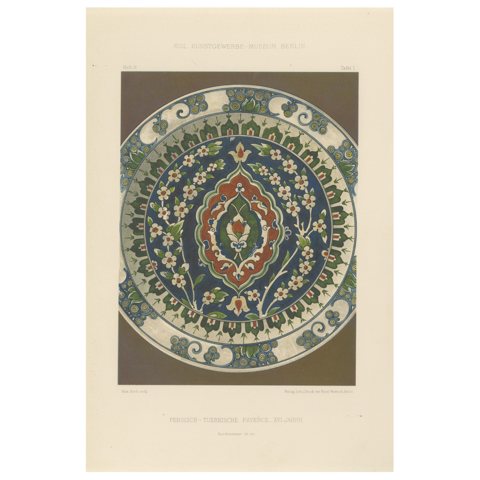
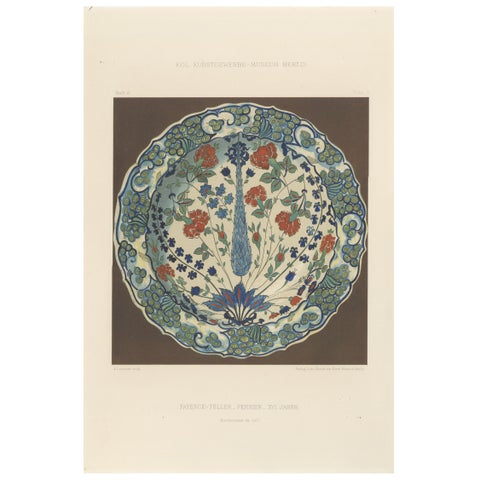
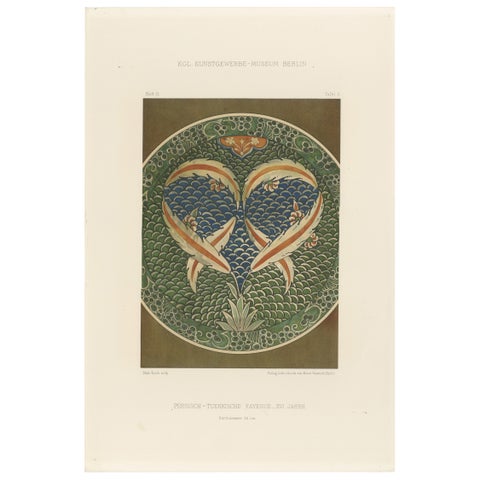
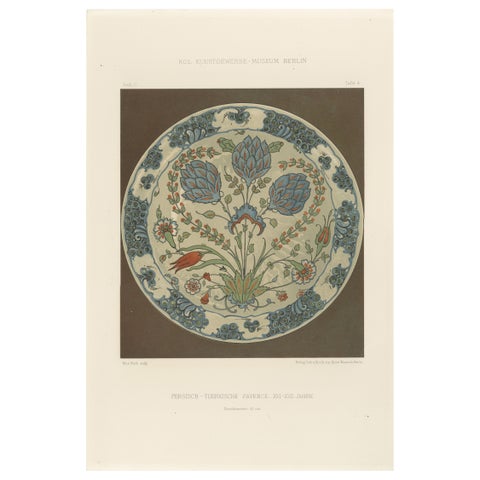
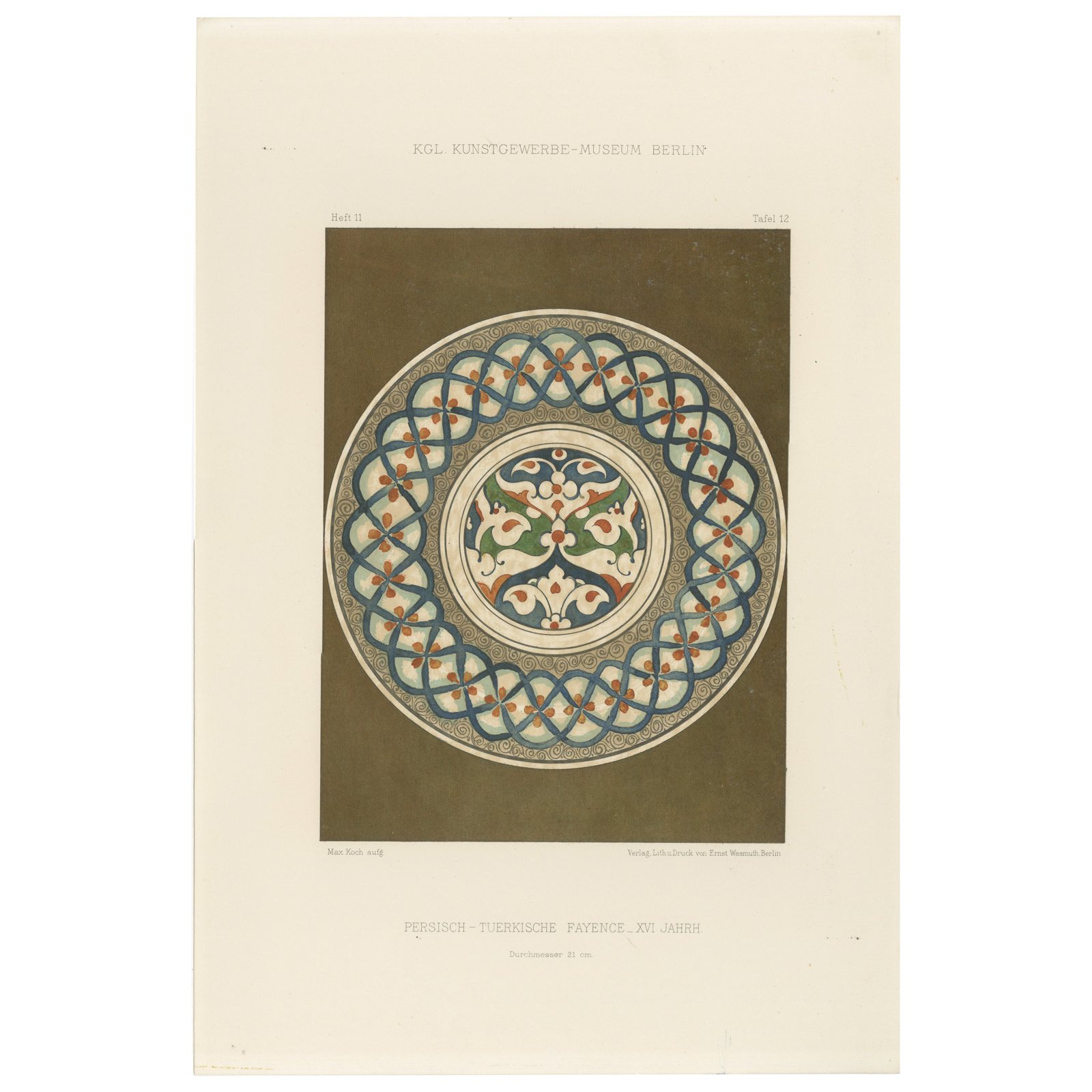
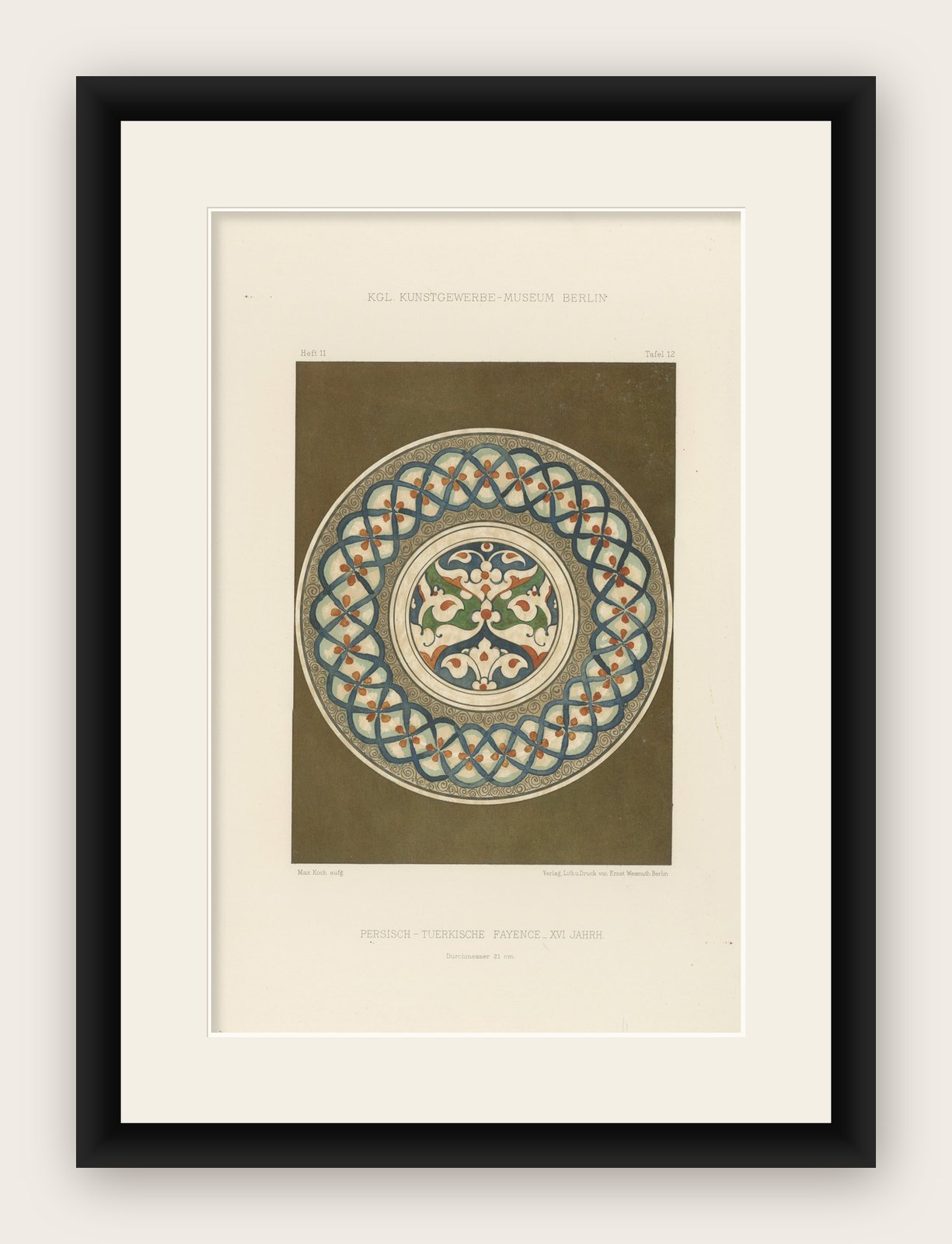
An elegant chromolithograph from Julius Lessing’s Persisch-Türkische Fayencen (Persian-Turkish Faience), published in Berlin by Ernst Wasmuth in 1890 as part of Vorbilder-Hefte aus dem Königlichen Kunstgewerbe-Museum, Heft 11. This plate (Tafel 12) reproduces a 16th-century Persian-Turkish faience dish from the Kgl. Kunstgewerbe-Museum Berlin (Royal Museum of Decorative Arts, Berlin).
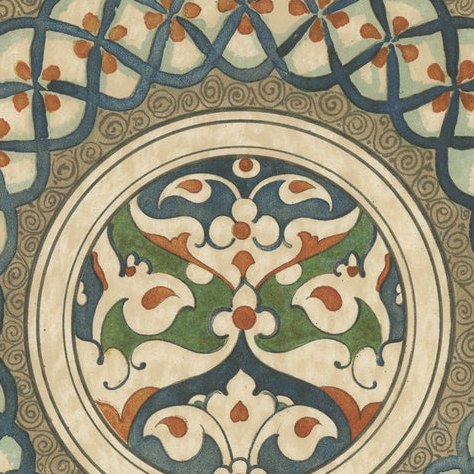
This print captures the refined geometric and floral harmony of early Ottoman ceramic design. The plate features a symmetrical interlaced border of turquoise and cobalt bands forming a rhythmic lattice of eight-pointed star shapes enclosing orange blossoms. The central medallion presents a stylized floral arabesque with red, green, and ivory tones, creating a balanced dialogue between geometry and natural ornamentation.
The design exemplifies the synthesis of Persian and Anatolian traditions in Ottoman faience production, notably from Iznik workshops around the mid-16th century. The color palette of soft turquoise, deep cobalt blue, and sienna-red, hallmarks of Iznik ceramics, reflects the influence of Islamic geometry and vegetal symbolism, representing unity and eternal life.
Drawn by Max Koch and printed by Verlag Lith. Druck von Ernst Wasmuth, Berlin, this lithograph exemplifies the meticulous craftsmanship and aesthetic sensibility of late 19th-century art publications. Under the guidance of Julius Lessing, the Vorbilder-Hefte series aimed to preserve and disseminate masterpieces of decorative art from museum collections worldwide, serving as invaluable resources for artists, craftsmen, and scholars.
Condition report:
Excellent preservation with bright, unfaded colors and crisp detail. Slight marginal toning, typical for age, but no stains or tears. Full margins intact.
Framing tips:
Best presented in a soft ivory or pale gray mat with a dark wood or bronze frame. Works beautifully as part of a coordinated display of Islamic or Oriental decorative designs.
Technique: Chromolithograph
Maker: Julius Lessing, Berlin, 1890