Close-ups
Framed and on the wall

Frame and rooms are illustrations of how the print could look, drawn to its real size; it is sold unframed unless the description says otherwise.
Antiquity & ruins
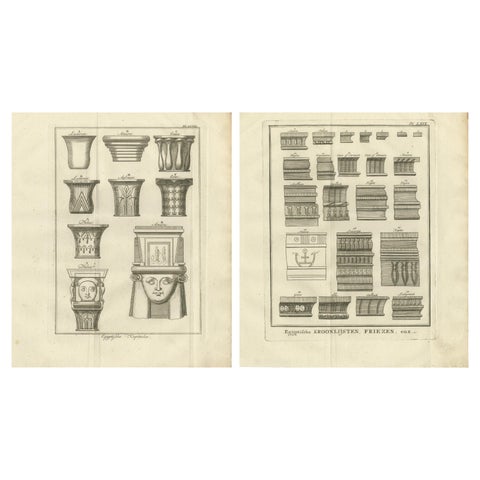
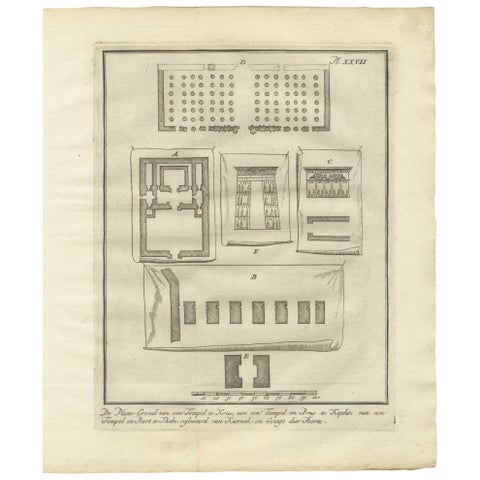
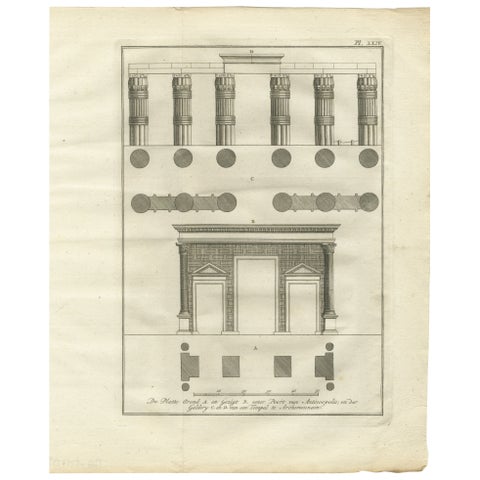
Architectural Engraving of Ancient Egyptian Columns and Capitals, c.1776
£220
$290 · €260
Original print, not a reproduction
Ships worldwide from the Netherlands, flat, insured and tracked. 14-day returns. To buy, use Ask a question (info@antiquearchitectureprints.com) and we will reserve it for you.
- Date
- 1776
- Sheet size
- 10.7 × 9.8 in (27.3 × 25 cm)
- Condition
- Excellent. Impression on laid paper. Central fold as issued. Slight toning around the edges, but no tears or foxing visible. Folding lines as isssued. Wide margins present.
- Collection
- Antiquity & ruins
- Era
- 1700 to 1789, Baroque to Neoclassical
- Stock no.
- f_46050412
Title: Architectural Engraving of Ancient Egyptian Columns and Capitals, c.1750
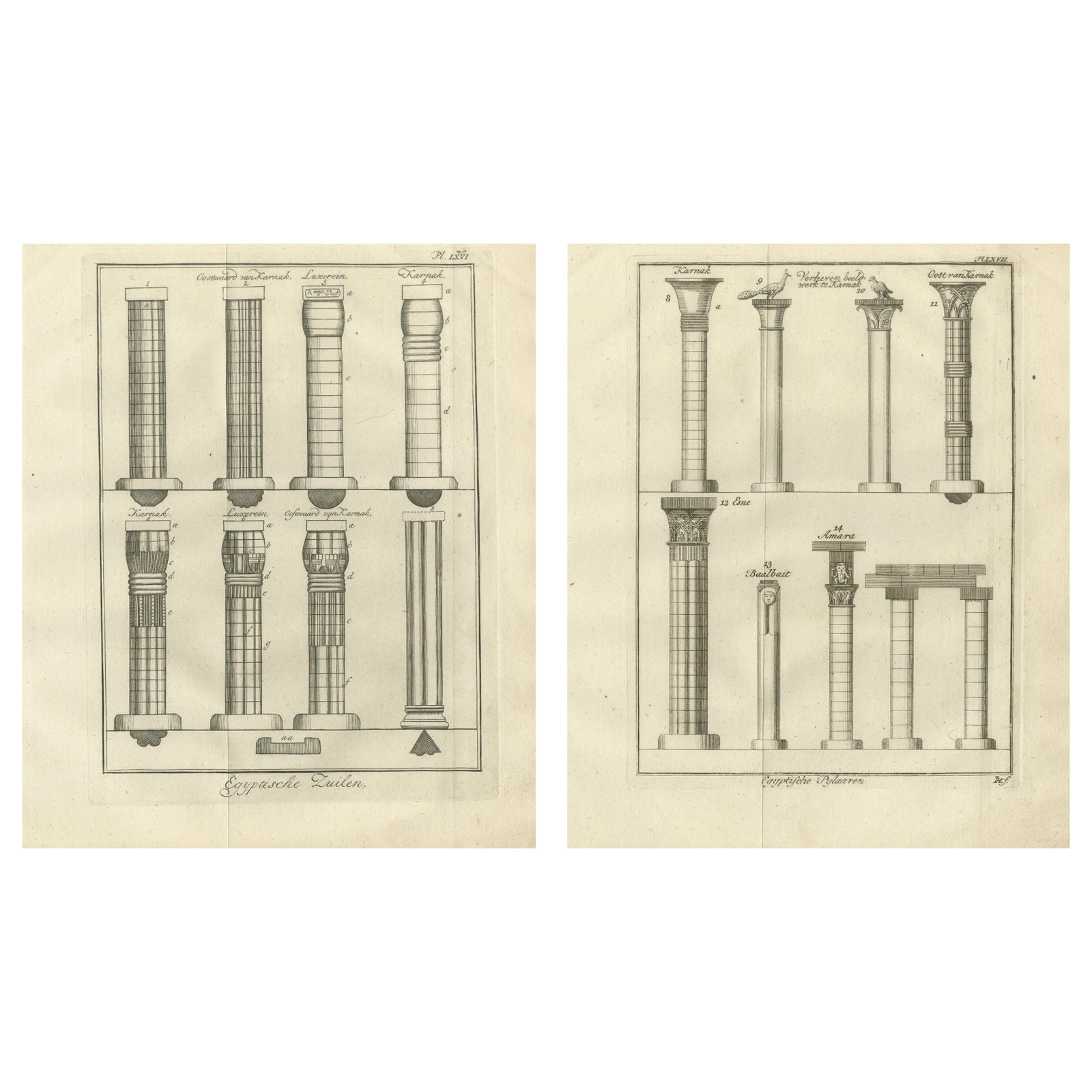
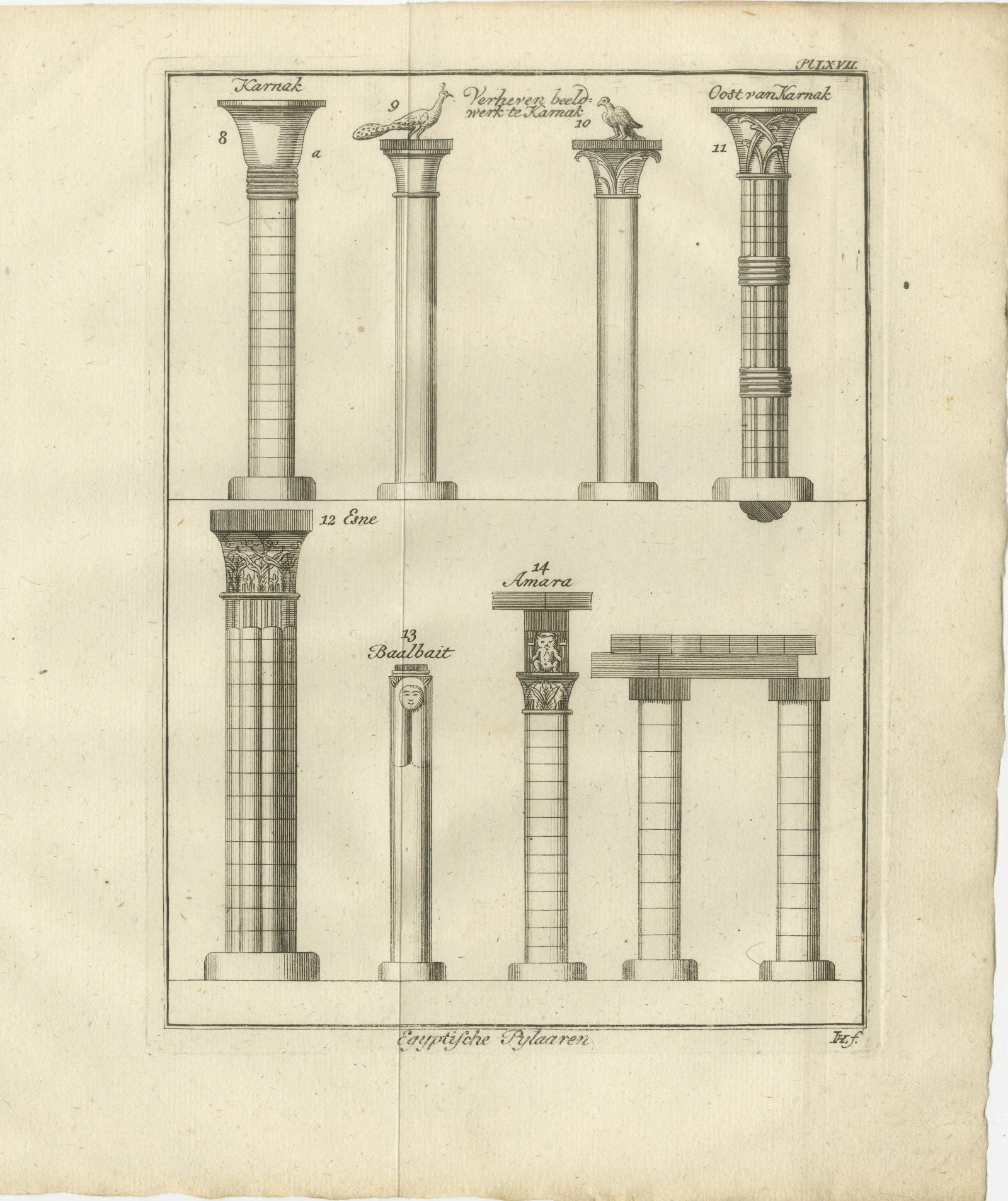
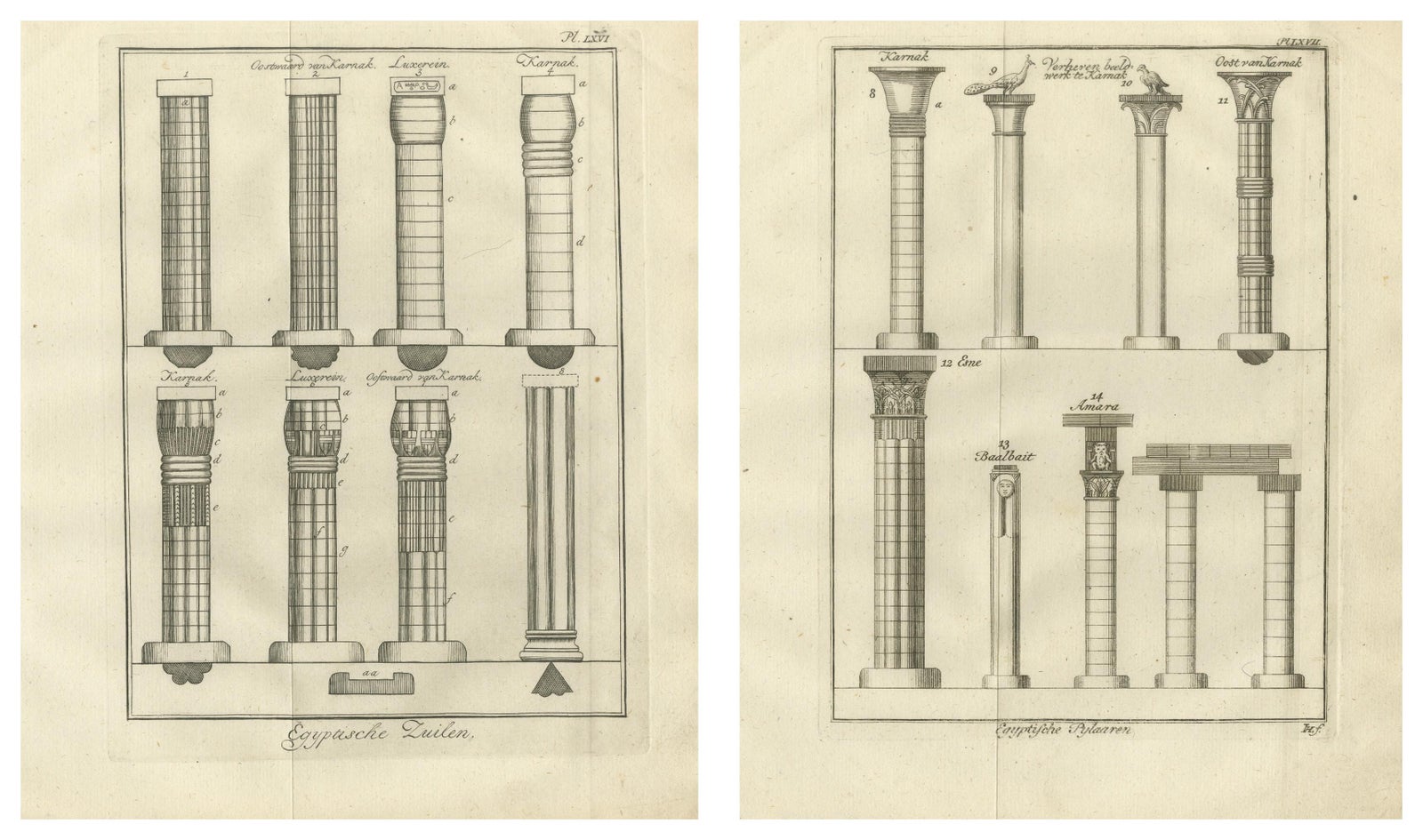
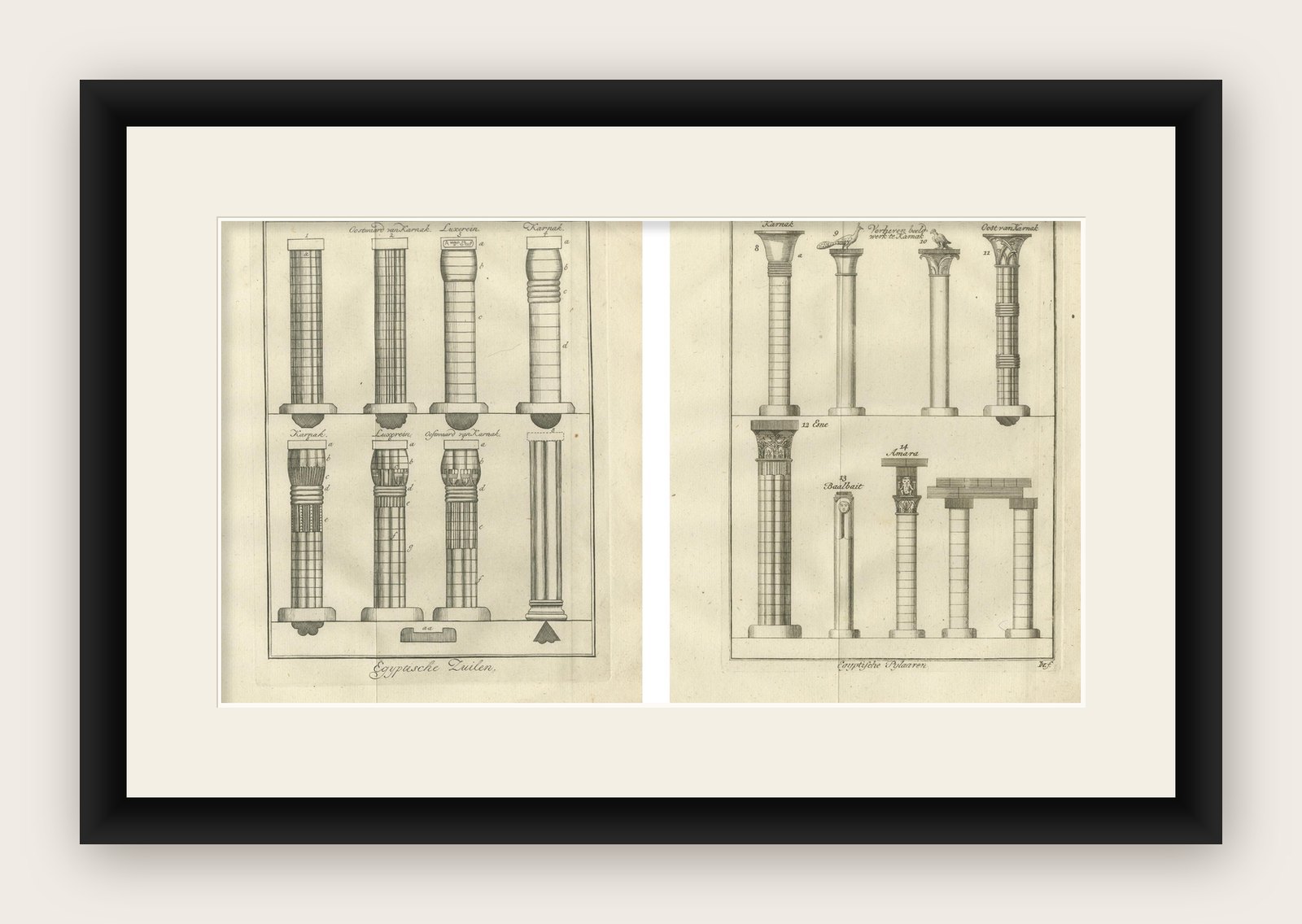
This antique architectural engraving presents a comparative study of various ancient Egyptian columns and capitals, showcasing their stylistic evolution and regional variations. The prints are titled in Dutch "Egyptische Zuilen" and "Egyptische Pilaren" (Egyptian Columns and Pillars), and are derived from an 18th-century scholarly work that aimed to document and disseminate the architectural wonders of Egypt to a European audience.
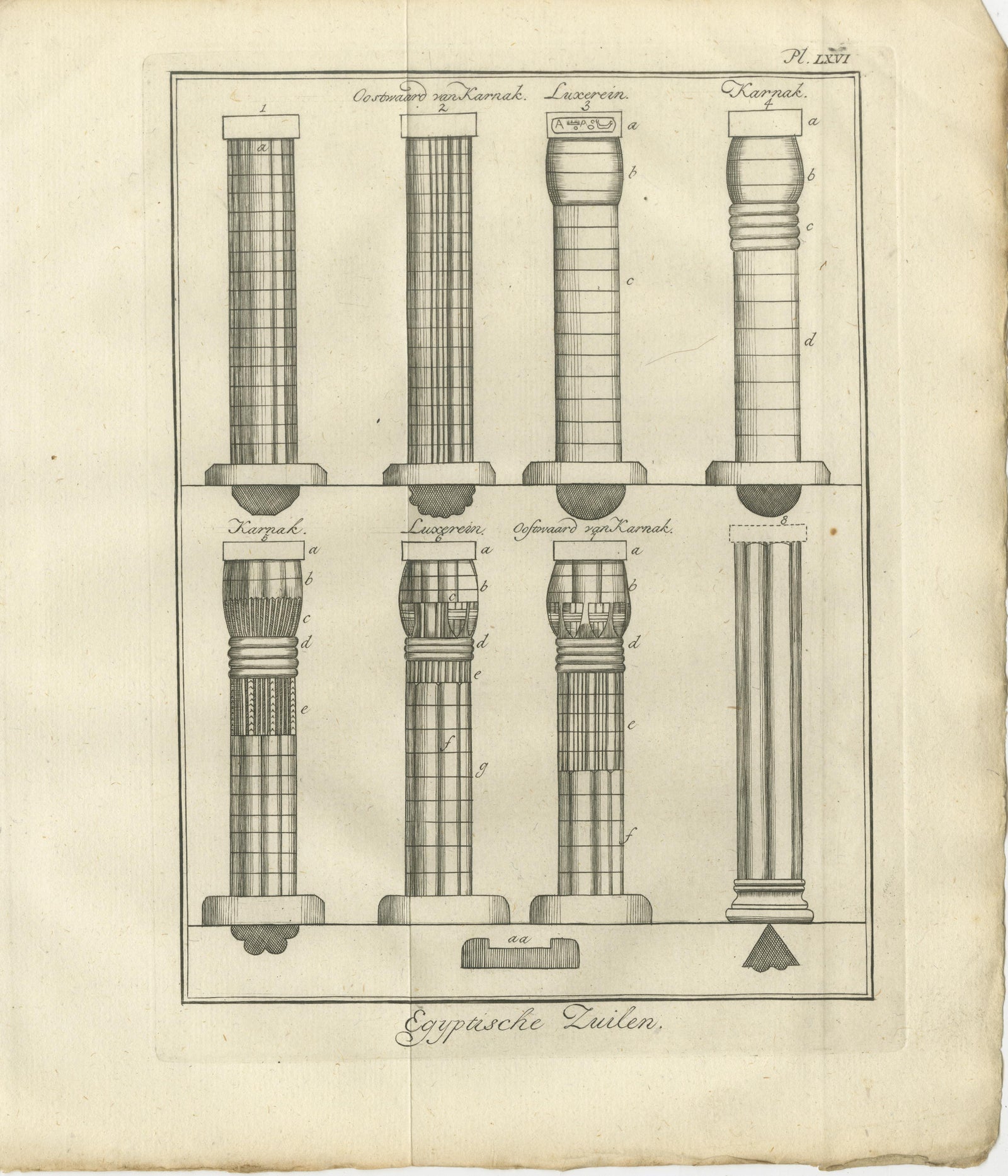
The engraving is divided across two plates. On the left sheet (Pl. LXVI), we observe a systematic representation of column shafts, mostly unadorned but differing in shape and proportion. Some include segmented fluting or papyrus-inspired detailing. The inscriptions above the columns identify their locations, such as Karnak, Luxor, and "Overblijfsel van Karnak", demonstrating how each temple complex developed its own distinct variant of the Egyptian architectural canon.
The lower half of the same plate shows more elaborate capitals with lotus, palm, and papyrus forms, indicative of different symbolic meanings and chronological phases. These botanical motifs, common in Egyptian temple decoration, not only reflect nature but also spiritual and political themes in Pharaonic architecture.
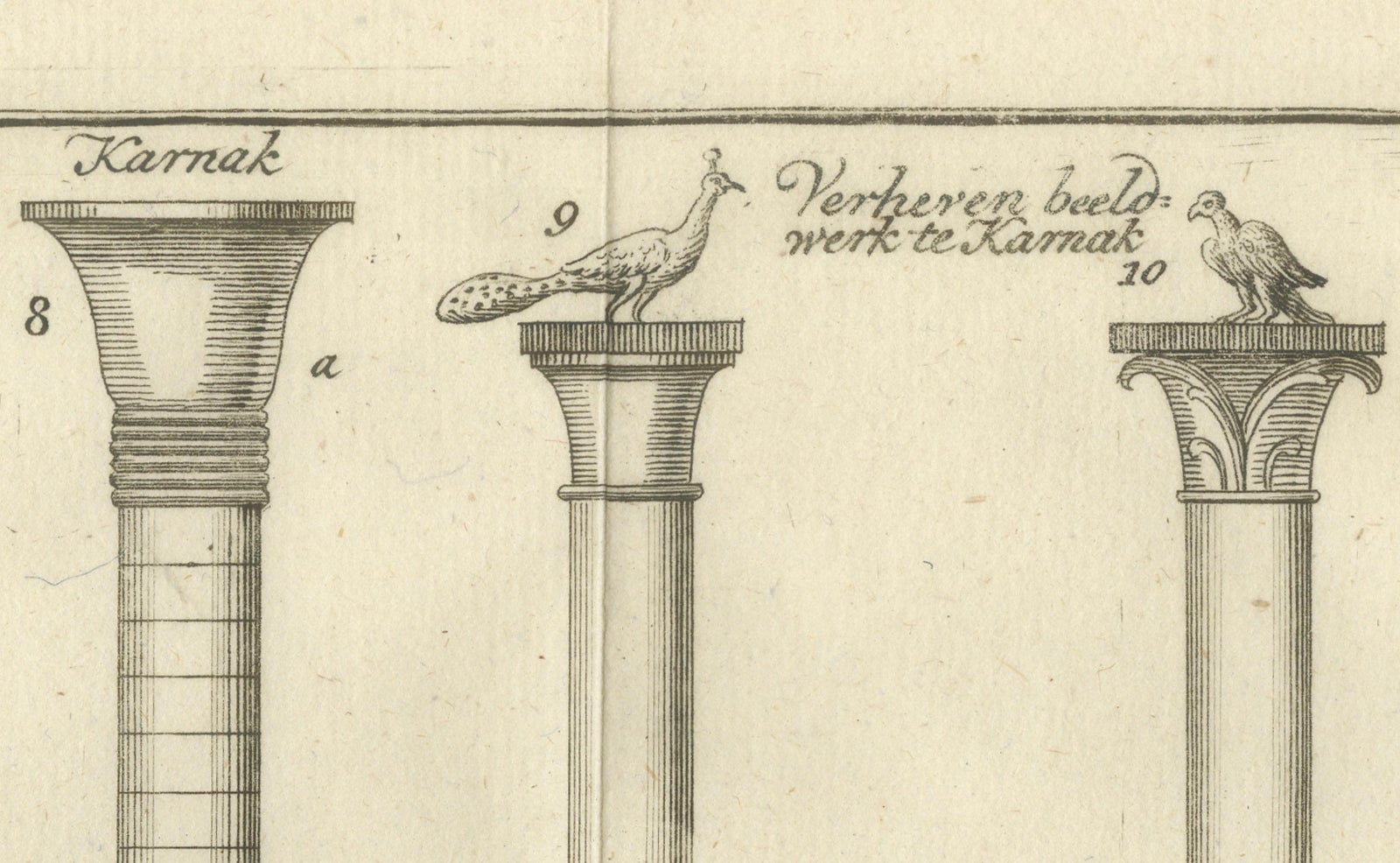
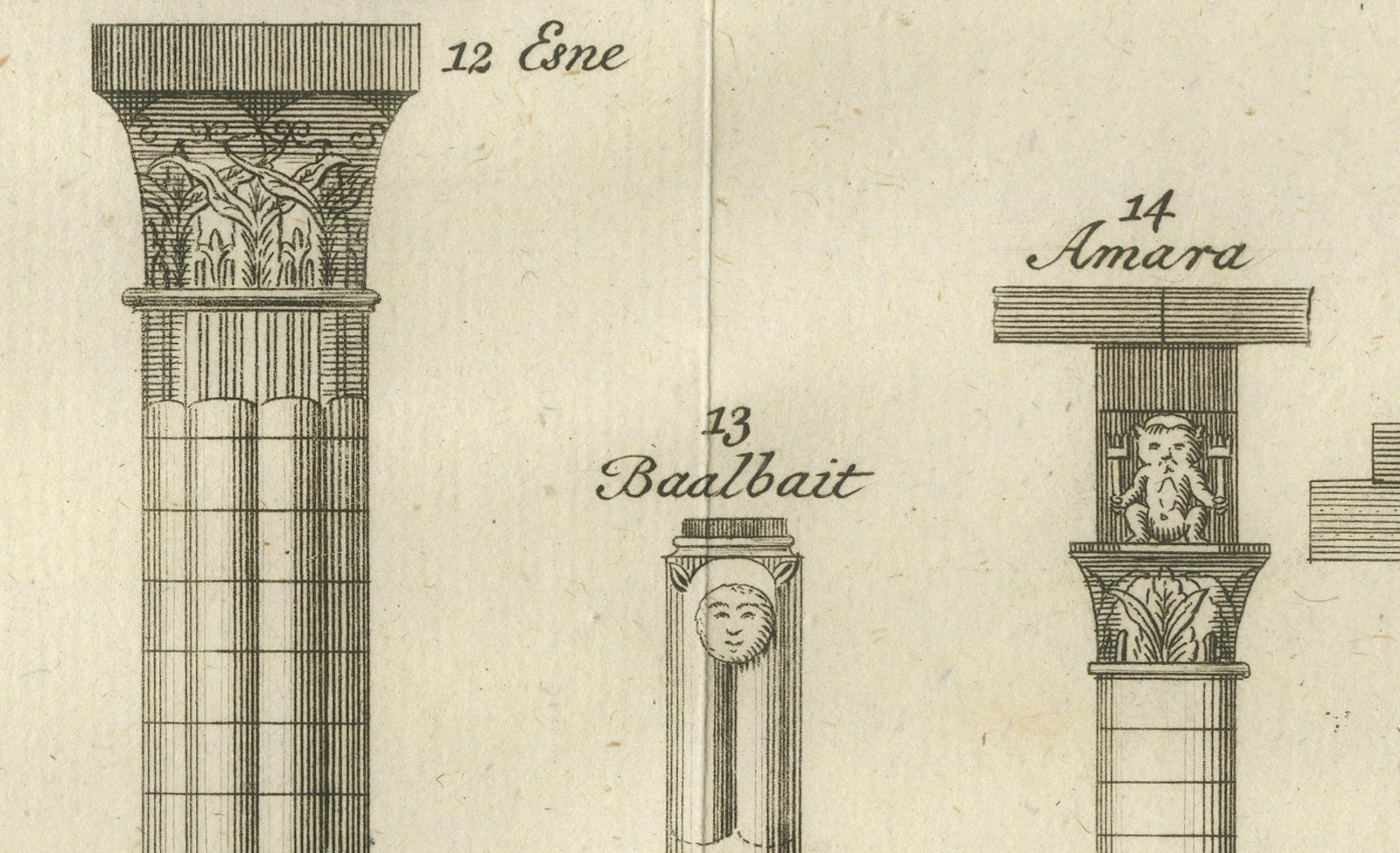
On the right-hand plate (Pl. LXVII), the columns become more refined and diverse, featuring capitals with animal figures, such as vultures and falcons, deities in ancient Egyptian belief. Column 13, labeled "Eene" (One), has a Corinthian-like capital adapted to Egyptian style. Column 14 from "Amira" is particularly notable, as it features a Hathoric capital, a woman's face with cow ears, associated with the goddess Hathor, often found in temples dedicated to fertility, motherhood, and music.
The column labeled "Baalbait" (13) appears to represent a column from Baalbek (though not Egyptian), indicating a comparative study beyond Egypt itself.
This engraving is valuable not only for its architectural accuracy but also for its role in shaping the Neoclassical understanding of ancient styles. It was likely used by architects and artists during the 18th century to replicate Egyptian motifs in European buildings, especially during the Egyptomania period following Napoleon’s campaigns.
Condition: Excellent impression on laid paper. Central fold as issued. Slight toning around the edges, but no tears or foxing visible. Folding lines as isssued. Wide margins present.
Framing tips: Best presented side-by-side in a single horizontal frame with double matting. A black or dark brown wooden frame with a parchment-colored mat will accentuate the linear structure and historical context.
Technique: Engraving
Maker: Anonymous, Dutch, circa 1750 to 1770